It all began here!!!

THE SMILE JOURNAL

It all began here!!!

4S Dentistree dental care

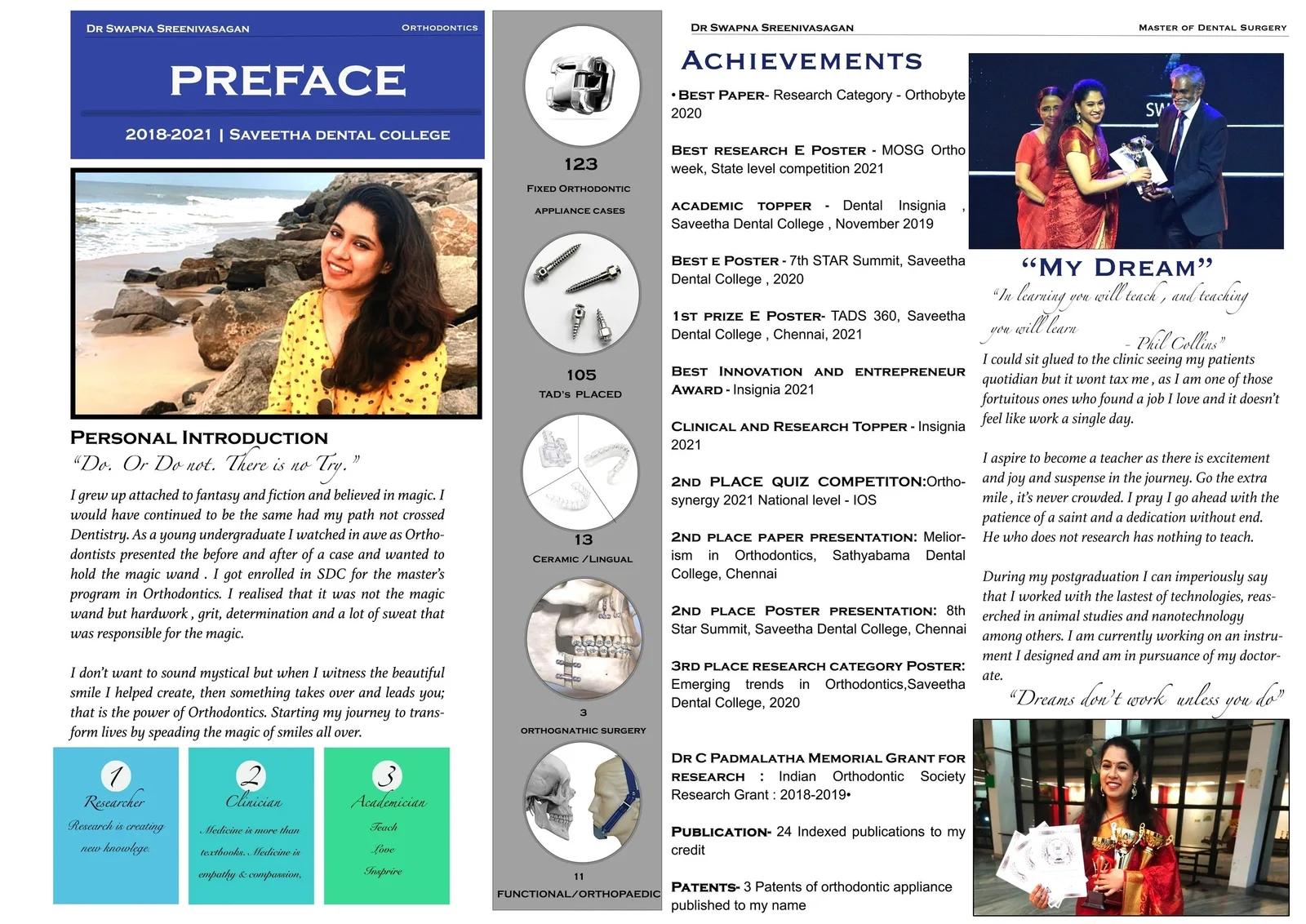
Completing my Masters in Orthodontics and Dentofacial Orthopaedics was undoubtedly a significant milestone in my journey. The feeling of accomplishment surged through me as I held that degree in my hands, a testament to years of hard work, dedication, and relentless pursuit of knowledge. Little did I know that it was just the beginning of a much more profound and humbling journey that awaited me.

Upon opening my own clinical practice, I was met with the realization that there is so much more to learn, countless skills to develop, and an array of aspects to focus on. From the meticulous setup of the clinic to the intricacies of the infrastructure and the expansive armamentarium required – each element demanded attention, precision, and a continuous thirst for improvement.

As I reflect on this past year, the journey has been both challenging and enlightening. Every step has brought with it new lessons and revelations. The humbling nature of this experience has underscored the fact that, despite the academic achievements, the practical application of knowledge in a real-world setting is an entirely different ball game.

The setup of the clinic, from choosing the right location to ensuring a welcoming environment, required careful consideration. It has been a year of growth, both professionally and personally. I have come to appreciate the dynamic nature of the field and the importance of adaptability. The challenges have been formidable, but with each hurdle, I have honed my skills and gained valuable insights.

. The realization has dawned upon me that there are miles to go, and the road ahead is adorned with opportunities for refinement and advancement.

To encapsulate this sentiment, I am reminded of the timeless words of Robert Frost in his poem "Stopping by Woods on a Snowy Evening":

"The woods are lovely, dark and deep, But I have promises to keep, And miles to go before I sleep, And miles to go before I sleep."

As I move forward, I embrace the challenges and relish the opportunities for growth. The first year may be behind me, but the journey has just begun – with miles to go before I rest, miles to go before I rest.

LET’S START WITH A CONVERSATION

Your next chapter.
A healthier smile.

A question, a concern, or a smile you’ve been thinking about. We’re here to listen.

Visit 4S Dentistree

No. 9, R 32, TNHB Commercial Complex,
120 Feet Road, TS Krishna Nagar, J J Nagar,
Mogappair East, Chennai 600050.

Monday – Sunday
10:00 am – 9:00 pm

Choosing the Right Family Dentist in Chennai: A Complete Guide

THE SMILE JOURNAL

Choosing the Right Family Dentist in Chennai: A Complete Guide

4S Dentistree dental care

Finding the right family dentist in Chennai is about much more than choosing a clinic that is close to home. Your family’s dental needs can change significantly with age. A young child may need preventive care and monitoring of developing teeth, teenagers may require braces or aligners, adults may need fillings, root canal treatment or cosmetic dentistry, while grandparents may require dentures, implants or other restorative dental treatments.

So, how do you choose a family dental clinic in Chennai that can care for your entire family while ensuring that each person receives the right treatment?

As an orthodontist who has treated more than 1,000 patients and has over 10 years of experience in dentistry, this is something I strongly believe patients should think about before choosing their long-term dental care provider.

What Should You Look for in a Family Dentist in Chennai?

The first thing I would look for is not simply the number of treatments a clinic offers. I would look at who is actually providing those treatments.

I am a strong believer in the principle: “Jack of all trades is master of none.”

Dentistry has evolved tremendously, and each speciality requires years of focused training and experience. An orthodontist is trained specifically to diagnose and treat orthodontic problems involving tooth alignment, bite and jaw development. An endodontist specialises in root canal treatment. A prosthodontist focuses on replacing and restoring teeth. A paediatric dentist is specially trained to manage the dental needs and behaviour of children.

That is why, in my practice, I believe in creating a team where every professional does what they are trained best to do.

One Dental Clinic, Multiple Specialities

A good family dentist in Chennai should ideally be able to identify when a patient needs specialist care.

In our practice, general dentists handle essential dental care such as:

Dental diagnosis and routine evaluation Dental X-rays and assessment Professional teeth cleaning and scaling Basic fillings Simple extractions Preventive dental care

When a patient requires specialised treatment, we bring in the appropriate specialist rather than attempting to manage every procedure ourselves.

I am closely associated with 15+ dental consultants across different specialities, including endodontics, cosmetic dentistry, prosthodontics, oral and maxillofacial surgery, implant dentistry and paediatric dentistry.

This means that when a patient walks into our clinic with a problem that requires specialist attention, we can arrange an appointment with the appropriate specialist.

For patients, this creates something very important: continuity of care and confidence that they are seeing the right professional for their specific dental problem.

Dental Care for Every Generation of Your Family

One of the biggest advantages of choosing a family dental clinic is continuity.

Imagine bringing your child to the same dental practice for regular check-ups. As they grow, their teeth and jaws can be monitored. If orthodontic treatment becomes necessary, the transition to an orthodontist can happen smoothly.

As an orthodontist, this is one of the areas I am particularly passionate about.

I have extensive experience in treating growing children, monitoring jaw development and planning orthodontic treatment at the right stage of growth. Early identification of orthodontic problems can sometimes make treatment simpler and more predictable.

For teenagers and adults, we provide orthodontic solutions including braces and clear aligners. We also have the ability to plan and fabricate aligners in-house, allowing us to have greater control over the digital workflow.

For patients with more complex jaw discrepancies, I also plan and treat cases that require orthognathic surgery, working as part of a multidisciplinary team.

But family dentistry does not stop at orthodontics.

The same family may need a paediatric dentist for a child, a root canal specialist for a parent, an implantologist or prosthodontist for a grandparent, and an orthodontist for another family member.

That is where a coordinated dental team becomes valuable.

Why Early Dental Diagnosis Matters

One of the most overlooked aspects of dentistry is prevention.

Many dental problems do not become painful immediately. A small cavity can progress. Gum disease can remain unnoticed for years. An orthodontic problem in a growing child may become more complicated if it is identified very late.

This is why regular dental check-ups, professional cleaning and appropriate X-rays when indicated are important.

We also regularly conduct dental awareness camps in surrounding communities. Our goal is not simply to treat dental problems after they become severe, but to help people understand their oral health and recognise problems early.

Sometimes, a simple dental examination and the right advice can prevent a problem from becoming a much bigger one.

A Dental Clinic Where You Feel Comfortable

For me, dentistry is not only about treatment. It is also about how a patient feels when they walk into the clinic.

Dental anxiety is very real. Some patients have had unpleasant experiences in the past and are nervous about visiting a dentist again. Others may be worried about pain, cost or the treatment itself.

My primary aim is to make patients comfortable, informed and confident about their treatment.

I believe patients should understand what is wrong, what their treatment options are, why a particular treatment is recommended and when specialist care is necessary.

Good dentistry should be built on trust, communication and clinical expertise.

When Your Dentist Becomes Your Family’s Long-Term Dental Partner

One of the most rewarding parts of running a dental practice is seeing families grow with us.

We have patients where we have treated a child with braces and later treated their parents for other dental needs. A grandmother may visit us for dentures or restorative treatment, while her children and grandchildren are also patients at the same clinic.

I have even had the privilege of treating a dentist friend with orthodontic treatment, after which several of his cousins also chose us for their orthodontic care.

For me, these referrals mean much more than simply gaining another patient.

They represent trust.

When someone recommends your dental clinic to their parents, children, siblings, cousins or friends, they are essentially saying, “I trust this team with my family.”

That is the kind of relationship I want to build with every patient who walks through our doors.

Choosing the Right Family Dentist in Chennai

When searching for the best family dentist in Chennai, don't look only at convenience or advertisements.

Ask yourself:

Does the clinic provide preventive care? Are children comfortable there? Can they recognise when specialist treatment is required? Are qualified specialists available? Can the clinic manage different dental needs within the family? Does the dentist explain treatment options clearly? Do you feel comfortable asking questions? Can you see yourself trusting this clinic for years to come?

Your family may need different dental treatments at different stages of life. The ideal family dental clinic in Chennai should therefore be one that understands this and has a system to connect you with the right dental professional when you need one.

At the end of the day, my goal is simple.

I want my clinic to be a place where your entire family can receive the dental care they need — from the first dental visit of a child to orthodontic treatment, restorative dentistry, implants, dentures and everything in between.

As an orthodontist, smile transformation is my passion. I believe in the magic that the right diagnosis, planning and clinical skills can create.

But more importantly, I believe in building a relationship where you don't just visit us for a treatment.

You trust us to travel with you and your family through every stage of your dental journey.

Because good dentistry can change a smile.

Great dentistry builds a relationship that lasts for generations.

LET’S START WITH A CONVERSATION

Your next chapter.
A healthier smile.

A question, a concern, or a smile you’ve been thinking about. We’re here to listen.

Visit 4S Dentistree

No. 9, R 32, TNHB Commercial Complex,
120 Feet Road, TS Krishna Nagar, J J Nagar,
Mogappair East, Chennai 600050.

Monday – Sunday
10:00 am – 9:00 pm

Clear Aligners Feeling Loose Mid-Treatment? 6 Real Reasons

THE SMILE JOURNAL

Clear Aligners Feeling Loose Mid-Treatment? 6 Real Reasons

4S Dentistree dental care

Your Clear Aligner Suddenly Feels Loose? Don't Panic.

You put your clear aligner in and something feels different.

Instead of the usual snug pressure, the tray feels loose. Maybe you notice a small gap between the plastic and your tooth. Perhaps the tray is lifting slightly when you talk, or one particular tooth doesn't seem to fit into the aligner anymore.

And naturally, you start wondering:

“Why does my Invisalign aligner feel loose halfway through treatment?”

A clear aligner feeling slightly less tight is not automatically a problem. As your teeth move, the tray is expected to become less tight before you progress to the next stage.

However, if your clear aligners feel loose much earlier than expected, if the tray is visibly not fitting properly, or if the fit becomes worse rather than better, it can indicate an aligner tracking issue.

Clear aligners are designed to move teeth in small, planned steps. When a tooth does not follow the planned movement closely enough, the next tray may not seat properly. Research shows that clear aligner tooth movement is not equally predictable for every type of movement, and refinements or additional intervention may sometimes be necessary.

So, what could be causing it?

1. Your Teeth Have Already Moved Into Position

This is the simplest explanation.

A new aligner is generally designed to be slightly more active on the teeth. As the teeth move, the aligner may gradually feel less tight.

That does not necessarily mean something is wrong.

In fact a new aligner may initially feel slightly tight and then begin to loosen as the teeth move to fit it.

The important question is:

Does the aligner feel loose because your teeth have completed the planned movement—or because your teeth are not tracking with the planned movement?

Those two situations can feel very similar to a patient but require completely different decisions.

What to do

Continue wearing the aligner according to your orthodontist's instructions and observe the fit.

If the next tray fits normally and there are no visible gaps or areas where the aligner is lifting, there may be no cause for concern.

2. You're Not Wearing the Aligners for Long Enough

This is one of the most common things to check when an aligner is not fitting properly.

Clear aligners only work while they are being worn.

Because they are removable, treatment depends heavily on wear compliance. Invisalign recommends approximately 20–22 hours of wear per day.

Taking them out frequently for meals, social occasions, travel or other activities can gradually reduce actual wear time.

You may think:

“I'm wearing them most of the day.”

But orthodontic treatment depends on consistent wear, not just occasional long periods.

Research on removable orthodontic appliances has also found that objectively measured wear can be lower than patients' self-reported wear.

What to do

For the next few days:

Aim for the prescribed daily wear time. Put your aligners back in immediately after eating and brushing. Avoid unnecessary periods without the aligners. Follow your orthodontist's prescribed change schedule.

Don't automatically jump to the next tray just because the current one feels loose.

3. The Aligner Isn't Tracking One or More Teeth

This is the situation orthodontists pay particular attention to.

Tray trackingmeans how closely the aligner is following the actual position of your teeth compared with the planned tooth movement.

Sometimes one tooth starts falling behind.

You may notice:

A visible gap between the aligner and tooth The tray lifting over one tooth An attachment no longer sitting properly inside the aligner One area feeling much looser than the rest The next aligner refusing to seat completely

This is an aligner tracking issue.

Clear aligners are capable of producing excellent results, but their predictability varies according to the type and magnitude of tooth movement. Systematic reviews have found that some movements remain less predictable and may require additional strategies or refinement.

What to do

Don't try to force the tooth into position yourself.

Your orthodontist may decide to:

Continue the current tray for longer Reassess the tooth movement Modify the treatment plan Add or replace an attachment Use an auxiliary Order refinement aligners

The correct solution depends on why the tooth stopped tracking.

4. An Attachment Has Come Off

Those tiny bumps on your teeth aren't just there for decoration.

Attachmentsare bonded onto selected teeth to help the aligner grip the tooth and deliver specific forces. Evidence suggests attachments can improve aligner retention and the expression of certain tooth movements.

So if one falls off, the tray may suddenly feel different.

You might notice that:

The aligner feels loose around that tooth. The tray doesn't “click” into place the same way. A particular tooth isn't tracking. The next aligner feels unusually tight or doesn't seat completely.

What to do

Contact your orthodontist.

Your orthodontist can determine whether the attachment needs to be replaced and whether the treatment sequence needs to be adjusted.

If you have lost an attachment but the tray still fits, don't assume the treatment is unaffected. The importance of that attachment depends on the movement being planned.

5. You're Not Using Your Chewies Correctly—or Your Orthodontist Hasn't Recommended Them

Some patients are prescribed aligner chewies or seating aids to help the tray seat more completely.

They can be useful when an aligner is not fully seated, but they are not a magic solution for every tracking problem.

A systematic review of randomized trials published in 2026 found that physical adjuncts have not consistently demonstrated improvements across clear-aligner treatment outcomes; the certainty of the evidence was low to very low.

So if your orthodontist has recommended chewies, use them exactly as instructed.

But if you have a significant gap between the tray and tooth, repeatedly chewing harder is not necessarily the answer.

What to do

Use your prescribed seating aid as directed.

If the tray still doesn't fit properly after appropriate seating, contact your orthodontist rather than trying to force it into place.

6. The Tray May Be Damaged, Distorted or No Longer Fitting Properly

Sometimes the problem isn't your teeth at all.

The aligner itself can become:

Cracked Distorted Warped Damaged during removal Altered by exposure to excessive heat

A distorted tray may feel loose even when your teeth are tracking correctly.

The AAO specifically advises patients to contact their orthodontist if an aligner is distorted or no longer fits properly.

What to do

Check the tray carefully under good lighting.

If it looks different from when you received it, don't assume your teeth are the problem.

Do not use hot water to clean your aligners, as excessive heat can distort the material. Invisalign also recommends storing aligners safely in their protective case when they are removed.

If the tray is damaged, ask your orthodontist what to wear temporarily rather than improvising with another tray.

Is It Normal for Aligners to Feel Loose?

Sometimes, yes.

A tray can become less tight as your teeth move into the position planned for that stage.

But there is an important difference between:

“This tray has become comfortably loose because my teeth have moved.”

and

“This tray is loose because one or more teeth aren't following the treatment plan.”

You cannot always tell the difference just by how the tray feels.

That is why regular orthodontic check-ups are important during clear aligner treatment.

What Happens If Invisalign Tray Doesn't Fit Tight?

If your Invisalign tray doesn't fit tightly, don't immediately move to the next tray.

First check:

Are you wearing the aligner for the prescribed number of hours? Is the tray fully seated? Is there a visible gap around any tooth? Has an attachment fallen off? Is the aligner cracked or distorted? Does the previous tray still fit differently?

If the problem persists, contact your orthodontist.

Depending on the cause, they may recommend continuing the current tray, returning temporarily to a previous tray, replacing an attachment, extending the wear period or modifying the treatment plan.

The right solution depends on the individual case.

When Should You Contact Your Orthodontist?

A slightly looser tray toward the end of its prescribed wear period may be completely normal.

But contact your orthodontist if:

Your aligner suddenly becomes very loose. You see a significant gap between the tray and your tooth. One tooth appears not to be tracking. An attachment has fallen off. The next tray does not fit properly. The tray is cracked, warped or distorted. The aligner remains poorly fitting despite consistent wear. You experience significant pain or unusual discomfort.

If your tray doesn't tighten back up or improve in fit within 2–3 days, a mid-treatment check-in at 4s Dentistree is a sensible next step.

LET’S START WITH A CONVERSATION

Your next chapter.
A healthier smile.

A question, a concern, or a smile you’ve been thinking about. We’re here to listen.

Visit 4S Dentistree

No. 9, R 32, TNHB Commercial Complex,
120 Feet Road, TS Krishna Nagar, J J Nagar,
Mogappair East, Chennai 600050.

Monday – Sunday
10:00 am – 9:00 pm

Invisible Aligners vs Braces: Which Is Right for You?

THE SMILE JOURNAL

Invisible Aligners vs Braces: Which Is Right for You?

4S Dentistree dental care

There is so much hype surrounding invisible aligners today. From social media and advertisements to celebrities and influencers, clear aligners are often presented as the modern alternative to braces.

But when patients ask me, “Doctor, should I get aligners or braces?”, my answer is not always the same.

Because the real question is not:

“Which one is more popular?”

The real question is:

“Which one is right for your teeth?”

As an orthodontist, I strongly believe that treatment should begin with diagnosis, not with choosing an appliance. There are patients who are excellent candidates for clear aligners, and there are patients for whom braces may provide better control.

In fact, the American Association of Orthodontists also emphasizes that there is no single orthodontic appliance that is right for every patient; the choice depends on the malocclusion, treatment goals and individual needs.

So, when comparing aligners vs braces, let's look at the actual clinical situations where one may have an advantage.

When Can Clear Aligners Be a Better Option?

1. Patients Who Cannot Tolerate Conventional Metal Wires

Some patients have concerns about metal orthodontic appliances, including sensitivity or nickel allergy.

For appropriately selected patients, clear aligners can provide an alternative to conventional fixed braces, without using traditional archwires.

The aligner is custom-made to fit over the teeth and progressively guide them towards the planned position.

2. Certain Molar Distalization Cases

Molar distalization means moving the back teeth backwards to create space or correct certain bite relationships.

This can be an effective application of clear aligner therapy in carefully selected cases because the aligner can engage multiple teeth while directing movement of the planned tooth or teeth.

However, this does not mean every distalization case should automatically be treated with aligners. Recent systematic reviews show that clear aligners can achieve maxillary molar distalization, but the amount of movement achieved can vary considerably from the planned movement, particularly when larger movements are prescribed. Attachments, elastics or skeletal anchorage may sometimes be required.

This is why treatment planning matters more than the brand of aligner.

3. Selected Deep Bite Cases

Deep bite is another situation where aligners can be useful.

One of the movements involved in correcting a deep bite is vertical tooth movement, including intrusion. In carefully planned cases, aligners can provide a comfortable alternative to fixed appliances with an anterior bite plane.

I have had patients come to me after having a fixed anterior bite plane placed who complained that they were finding it difficult to pronounce certain words, eat comfortably or adapt to the appliance.

For appropriately selected patients, aligners can be a useful option.

But again, “aligners are good for deep bite” does not mean every deep bite should be treated with aligners. The exact cause and mechanics of the bite need to be assessed first.

4. Patients Who Play Sports or Have an Active Lifestyle

Think about someone who plays contact sports, works out regularly or has a very active lifestyle.

With fixed braces, brackets can be damaged or become uncomfortable following trauma to the mouth.

Aligners can sometimes be a more convenient option for these patients, particularly when appropriate mouth protection is also used for sports.

I also see patients who tend to clench their teeth while lifting weights or during intense physical activity. In selected cases, avoiding conventional brackets and wires may make their orthodontic treatment more comfortable.

5. Patients With Strong Clenching or Bruxism Habits

Patients with bruxism or significant clenching habits require individual assessment.

For some of these patients, aligners can provide an alternative to fixed orthodontic appliances because the teeth are covered by the aligner rather than having brackets and wires directly exposed.

However, bruxism does not automatically make someone an aligner candidate. The severity of the habit, tooth wear, periodontal health and orthodontic requirements still need to be evaluated.

But Is It Just About Appearance?

Not at all.

When people talk about clear aligners , the biggest selling point is often that they are transparent.

And yes, this is a major advantage.

They are discreet, removable and can make orthodontic treatment less noticeable.

But my decision as an orthodontist should not be based only on whether the appliance is invisible.

I am more interested in what tooth movement is required and how predictably we can achieve it.

That brings us to braces.

When Can Braces Be a Better Option?

1. Severely Rotated Teeth

Severely rotated teeth can be challenging to move predictably with aligners.

Aligners can be used in some rotation cases, but complex rotations may require attachments, additional aligners or refinements.

Fixed braces give the orthodontist direct control through the bracket-wire system and can therefore be advantageous for certain difficult rotations. Current reviews continue to identify rotation and other complex movements as areas where clear aligner predictability can be limited.

2. Severe Crowding and Extraction Cases

Severe dental crowding sometimes requires extraction and carefully controlled tooth movement.

This does not mean that extraction cases cannot be treated with aligners. They can.

However, depending on the case, braces may provide greater control and may allow certain movements to be completed more efficiently.

The decision should be based on the amount and type of movement required—not simply on whether the patient prefers aligners.

3. Impacted Teeth

An impacted tooth is a tooth that has not erupted normally and may remain trapped within the bone.

Disimpaction can be one of the more challenging orthodontic procedures because the tooth often needs to be surgically exposed and then carefully guided into its correct position.

These cases may require brackets, elastics, springs or other orthodontic auxiliaries to provide the necessary control.

In complex impacted-tooth cases, fixed appliances can therefore be particularly useful.

4. Difficult Tooth Uprighting

Another challenging movement is uprighting a severely tilted tooth, such as a molar that has tipped into an extraction space.

With braces, the orthodontist can incorporate auxiliaries such as springs to produce controlled movement.

Aligners may still be part of the treatment plan in selected situations, but complex movements often require additional attachments, elastics or a combination of orthodontic techniques.

So, Braces or Aligners: Which Is Better?

The answer is simple:

Neither is universally better.

The right treatment depends on the patient.

Clear aligners can be excellent for selected cases involving certain types of alignment, intrusion, distalization and lifestyle considerations. Braces can provide excellent control for complex rotations, difficult uprighting, severe crowding, extraction mechanics and impacted teeth.

And sometimes the answer isn't aligners OR braces.

It may be:

Aligners + attachments + elastics + orthodontic auxiliaries.

Modern orthodontics gives us multiple tools. The skill lies in knowing which tool to use, when to use it and how to combine it when necessary.

What Should You Consider Before Choosing Aligners or Braces?

Before deciding on clear aligners or conventional braces, your orthodontist should evaluate:

Your bite and type of malocclusion Tooth position and rotation Amount of crowding Need for extractions Impacted teeth Required tooth movements Gum and bone health Growth and jaw development Your lifestyle and expectations Treatment compliance Cost and convenience

Clear aligners are removable, which means patient compliance is important. The American Association of Orthodontists notes that aligners are generally worn for most of the day and are designed to move teeth incrementally according to the orthodontist's treatment plan.

The Right Question Isn't “Which Is More Popular?”

If you are searching online for “aligners vs braces Chennai” or asking “braces or aligners which is better?”, don't start by choosing the appliance.

Start with a proper orthodontic consultation.

First identify the problem.

Then decide what movement is required.

Then choose the appliance that gives the orthodontist the best control while also considering your comfort, lifestyle, expectations and budget.

Aligners can be amazing.

Braces can be amazing.

But neither should be chosen simply because they are trending.

The real goal of orthodontic treatment is not to sell you an appliance.

It is to move your teeth safely, predictably and appropriately for your individual smile and bite.

That is why, in 4S Dentistree practice, I believe the diagnosis comes first and the appliance comes second.

Because the best orthodontic treatment isn't necessarily the one that looks the best on Instagram.

It is the one that is right for you.

Frequently Asked Questions

1. Are clear aligners better than braces?

Neither is universally better. Clear aligners and braces have different strengths. The right option depends on the patient's malocclusion, required tooth movements, lifestyle, compliance and treatment goals.

2. Are clear aligners suitable for everyone?

No. Some orthodontic problems are more difficult to manage predictably with aligners, particularly certain complex rotations, difficult vertical movements and some complex extraction or impacted-tooth cases. An orthodontic assessment is necessary before choosing aligners.

3. Are aligners good for deep bite?

Aligners can be useful for selected deep bite cases, particularly when controlled vertical tooth movement is required. However, the cause and severity of the deep bite determine whether aligners are appropriate.

4. Can aligners move molars backwards?

Yes. Clear aligners can be used for molar distalization in selected cases. However, the amount of movement achieved may differ from the amount planned, and some patients may require attachments, elastics or skeletal anchorage.

5. Are braces faster than aligners?

Treatment time depends on the complexity of the case, the movements required and patient compliance. Braces can provide greater control for some complex movements, while aligners can be efficient for appropriately selected cases. Treatment duration should therefore be estimated individually.

6. Can severe crowding be treated with clear aligners?

Some severe crowding cases can be treated with aligners, including selected extraction cases. However, complex crowding may require additional attachments, elastics, refinements or fixed appliances. The treatment plan should be based on the individual case.

7. Can impacted teeth be treated with aligners?

Some impacted teeth can be incorporated into an aligner-based treatment plan, but complex disimpaction often requires additional orthodontic auxiliaries or fixed appliances to provide adequate control.

8. How do I choose between braces and aligners?

Start with an orthodontic consultation rather than choosing the appliance yourself. Your orthodontist should evaluate your bite, tooth position, crowding, required movements, gum health, lifestyle and treatment goals before recommending braces, aligners or a combination approach.

LET’S START WITH A CONVERSATION

Your next chapter.
A healthier smile.

A question, a concern, or a smile you’ve been thinking about. We’re here to listen.

Visit 4S Dentistree

No. 9, R 32, TNHB Commercial Complex,
120 Feet Road, TS Krishna Nagar, J J Nagar,
Mogappair East, Chennai 600050.

Monday – Sunday
10:00 am – 9:00 pm

You Had a Root Canal… So Why Does Your Tooth Still Hurt?

THE SMILE JOURNAL

You Had a Root Canal… So Why Does Your Tooth Still Hurt?

4S Dentistree dental care

You finally had the root canal.

The infection has been treated. The nerve inside the tooth has been removed. You were expecting the pain to disappear.

But a day or two later, you bite down and feel a dull ache.

Or the tooth feels tender when you touch it.

And then comes the worrying thought:

“Did my root canal fail?”

If you are experiencing pain after root canal treatment, you are not necessarily dealing with a failed treatment.

Some soreness or tenderness for a few days can be a normal part of healing, particularly if the tooth was infected or painful before treatment. Mild soreness or tenderness for a few days is common and should generally improve as the surrounding tissues heal.

Research also shows that post-treatment pain is not unusual. A systematic review found that pain prevalence falls substantially after root canal treatment, with pain levels generally dropping from the first day through the first week.

So the important question isn't simply:

“Does it hurt?”

It is:

“What kind of pain am I having, and is it getting better or worse?”

Is Pain After Root Canal Treatment Normal?

Mild discomfort can be normal.

Even though the infected pulp has been removed, the tissues surrounding the root of the tooth are still present. If these tissues were irritated by the original infection or by the treatment itself, they may need some time to settle.

You may experience:

Mild soreness

Tenderness when biting

A feeling that the tooth is slightly different from the surrounding teeth

Mild sensitivity around the treated area

Some jaw soreness from keeping your mouth open during the procedure

These symptoms can occur for a few days following treatment and usually improve during the healing period.

One systematic review found that average post-treatment pain decreased substantially within the first 24 hours and was minimal for most patients by one week.

So if your tooth is a little sore but getting better each day, that is generally more reassuring than pain that is becoming progressively worse.

Why Does My Tooth Still Hurt After a Root Canal?

There isn't just one explanation.

Here are some of the most common possibilities.

1. The Area Around the Root Is Still Healing

This is one of the simplest explanations.

A root canal treats the inside of the tooth, but the tissues surrounding the root may have been inflamed before treatment.

If there was a significant infection or abscess before the root canal, those tissues don't instantly return to normal the moment treatment is completed.

Think of it like treating an infection:

The cause may have been treated, but the surrounding tissues still need time to recover.

This is why some patients experience tenderness when biting for several days after treatment.

What you can do

Follow the medication and aftercare instructions given by your dentist or endodontist.

Unless you have been specifically advised otherwise, avoid chewing hard foods on the treated tooth while it is recovering or until it has been permanently restored.

2. Your Tooth Was Already Very Inflamed or Infected

A tooth that was severely painful before the root canal may take longer to settle than a tooth that had little or no pre-treatment pain.

Research has consistently shown that postoperative pain can occur even after appropriately performed root canal treatment.

So don't judge the success of the treatment based solely on how you feel in the first 24–48 hours.

3. Your Bite May Feel Different

Sometimes patients say:

“The root canal tooth hurts every time I bite.”

One possibility is that the tooth is taking more biting force than it should because the bite is slightly uneven after treatment or restoration.

Contact the dentist if your bite feels unevenafter root canal treatment.

This is worth checking rather than simply tolerating the discomfort.

What to do

Tell your dentist exactly what you feel:

“The tooth hurts when I bite down, and it feels like this tooth touches first.”

Your dentist can examine the bite and determine whether the restoration or another factor needs attention.

4. The Temporary Filling or Crown May Be a Problem

Depending on how your treatment was completed, you may have a temporary filling or temporary crown before the final restoration.

If it becomes loose or comes out, the tooth needs to be assessed.

A root canal is not necessarily the final step.

The treated tooth often needs a permanent restoration to protect it from fracture and restore its function. The timing and type of restoration depend on the tooth and the amount of remaining tooth structure.

5. The Original Problem May Not Be Completely Resolved

This is where persistent or worsening pain deserves proper evaluation.

A root canal can occasionally require additional treatment.

Possible reasons include:

Complex or unusual root canal anatomy

A canal that was not fully treated

Persistent or recurrent infection

A breakdown of the restoration or seal

New decay

A crack or fracture

New infection developing later

An endodontically treated tooth can occasionally fail to heal or can develop disease months or years later, and in some cases retreatment or endodontic surgery can save the tooth.

This does not mean that persistent pain automatically means the root canal was done incorrectly.

It means the tooth needs to be diagnosed rather than guessed about.

6. The Pain May Not Actually Be Coming From the Root Canal Tooth

This is something patients often don't realize.

Pain felt in a particular area does not always identify its exact source.

For example, pain may sometimes be related to:

A neighboring tooth

A cracked tooth

Bite or clenching forces

Sinus-related pain in some upper teeth

Other non-tooth-related sources of facial pain

Some tooth-region pain can have nonodontogenic causes, which is one reason persistent pain requires proper examination rather than automatically assuming the root canal has failed.

This is also why your dentist may need to examine more than just the tooth that had the root canal.

Contact your dentist or endodontist if you experience:

🚩 Severe pain or pressure

If the pain is severe, persistent or continues beyond the expected early healing period, it should be evaluated. Contact an endodontist for severe pain or pressure lasting more than a few days.

🚩 Increasing pain instead of decreasing pain

Your pain should generally trend toward improvement.

If you were feeling better and then suddenly become significantly worse, don't simply wait it out.

🚩 Swelling

Visible swelling inside or outside the mouth is a reason to contact your dentist promptly.

🚩 The symptoms you had before treatment return

If the same severe toothache, swelling or other symptoms that led to the root canal come back, the tooth needs reassessment.

🚩 Your bite feels uneven

If the tooth feels like it is hitting first or is painful every time you bite, tell your dentist.

🚩 Your temporary filling or crown comes out

Don't ignore it. Contact your dentist so the tooth can be protected appropriately.

What Can You Do for Pain After Root Canal Treatment?

Your first step should be to follow the specific instructions given by your dentist or endodontist.

Depending on your individual situation, your dentist may recommend an appropriate over-the-counter pain reliever or prescribe medication.

Don't take medication simply because someone else had the same procedure. Your medical history, other medicines and individual circumstances matter.

You can also:

Avoid chewing hard foods on the treated tooth.

Follow your prescribed medication schedule.

Maintain normal brushing and flossing, while being gentle around the area.

Attend your scheduled follow-up.

Complete the permanent restoration when advised.

And importantly:

Don't repeatedly press, tap or bite on the tooth just to “check” whether it still hurts.

If the area is healing, repeatedly testing it can simply irritate it.

How Long Should Pain Last After a Root Canal?

There isn't one exact number of days that applies to every patient.

Mild discomfort commonly lasts for a few days, with most patients improving within approximately 3–5 days.

Research also shows that pain tends to decrease substantially during the first week.

So rather than focusing only on the number of days, ask:

Is the pain getting better?

A mild ache that is steadily improving is generally more reassuring than pain that is becoming stronger, returning after it had improved, or occurring with swelling.

Can a Root Canal Tooth Hurt Months or Years Later?

It can happen, although it is not the expected course.

. Possible reasons include new decay, trauma, restoration problems or persistent/recurrent infection. Some teeth can be managed with retreatment or endodontic surgery.

Persistent tooth pain after endodontic treatment is relatively uncommon overall. A systematic review estimated persistent pain at six months or longer at around 5.3%, although the studies were heterogeneous and the causes of pain varied.

So long-term pain deserves investigation—but it doesn't automatically mean the tooth needs to be extracted.

A Simple Rule to Remember

After a root canal, think about three things:

Mild + improving = usually monitor

Some soreness or tenderness for a few days can be part of normal healing.

Severe or worsening = call

Increasing pain, significant pressure or swelling deserves professional assessment.

Persistent or returning = investigate

If the pain isn't settling, or the symptoms you had before treatment return, don't suffer silently.

Your dentist can determine whether the tooth is healing normally, whether the bite or restoration needs attention, or whether further endodontic evaluation is required.

Frequently Asked Questions About Pain After Root Canal Treatment

1. Is pain after root canal treatment normal?

Mild soreness or tenderness for a few days can be normal, especially if the tooth was infected or painful before treatment. The discomfort should generally improve rather than progressively worsen.

2. How long should pain last after a root canal?

Many patients experience mild discomfort for a few days, and symptoms commonly improve within approximately 3–5 days. Persistent or increasing pain should be assessed by your dentist or endodontist.

3. Why does my tooth still hurt after a root canal?

The surrounding tissues may still be healing, particularly if there was significant inflammation or infection before treatment. Other possibilities include an uneven bite, restoration-related problems, persistent infection, a crack or pain coming from another source.

4. Is it normal for a root canal tooth to hurt when biting?

Some tenderness when biting can occur during early healing. However, if the tooth feels like it is hitting first, the pain is severe, or the biting pain persists or worsens, contact your dentist for an assessment.

5. Can a root canal fail if the tooth still hurts?

Pain immediately after treatment does not mean the root canal has failed. However, persistent or returning pain, swelling or other symptoms may require further examination to determine whether additional treatment is needed.

6. What should I do if my root canal tooth hurts after one week?

If pain is still present after a week, particularly if it is not steadily improving, contact your dentist or endodontist. The tooth may simply need monitoring, but persistent symptoms deserve an examination rather than self-diagnosis.

7. Can I take painkillers after a root canal?

Your dentist may recommend an appropriate pain medication based on your individual circumstances. Follow the medication instructions provided to you rather than taking someone else's prescription or exceeding the recommended dose.

8. When should I call my dentist after a root canal?

Call your dentist if you have severe or increasing pain, significant pressure, swelling, an uneven bite, a temporary filling or crown that comes out, or a return of the symptoms you experienced before treatment.

9. Does swelling after a root canal mean there is an infection?

Swelling should not simply be assumed to be normal. Visible swelling inside or outside the mouth after treatment is a reason to contact your dentist or endodontist for assessment.

10. Should I wait for root canal pain to go away on its own?

If the pain is mild and clearly improving, monitoring it while following your dentist's aftercare instructions may be appropriate. If it is severe, worsening, associated with swelling, or persistent without improvement, contact your dentist rather than suffering silently.
LET’S START WITH A CONVERSATION

Your next chapter.
A healthier smile.

A question, a concern, or a smile you’ve been thinking about. We’re here to listen.

Visit 4S Dentistree

No. 9, R 32, TNHB Commercial Complex,
120 Feet Road, TS Krishna Nagar, J J Nagar,
Mogappair East, Chennai 600050.

Monday – Sunday
10:00 am – 9:00 pm

4S Dentistree: Your Trusted Dental Clinic in Mogappair

THE SMILE JOURNAL

4S Dentistree: Your Trusted Dental Clinic in Mogappair

4S Dentistree dental care

Table of Contents

Looking for a Dental Clinic in Mogappair? Meet 4S Dentistree Why 4S Dentistree Stands Out Among Dental Clinics in Mogappair Dental Services at 4S Dentistree What to Expect on Your First Visit Signs It's Time to See a Dentist Simple Habits for Healthy Teeth Between Visits How to Find 4S Dentistree in Mogappair East Frequently Asked Questions Book Your Visit to 4S Dentistree Today

Looking for a Dental Clinic in Mogappair? Meet 4S Dentistree

A toothache rarely waits for a convenient time. Neither does the wish for a straighter, brighter smile. When you need care, you want a dentist close to home who listens, explains clearly and treats you gently.

If you live in Mogappair, Anna Nagar West, JJ Nagar or nearby, 4S Dentistree is a dental clinic built around exactly that. Located on 120 Feet Road in Mogappair East, the clinic offers complete family dentistry under one roof, from routine check-ups to advanced orthodontic care.

The clinic's promise is simple: Your smile. Our Passion. In this guide, you will learn what makes 4S Dentistree a trusted dental clinic in Mogappair, which treatments it offers, and how to plan your first visit.

Why 4S Dentistree Stands Out Among Dental Clinics in Mogappair

Mogappair has many dental clinics. Here is why families keep choosing 4S Dentistree.

Specialist-led care. The clinic is led by Dr Swapna Sreenivasagan, M.D.S (Orthodontics), PhD, who completed her postgraduation and doctorate at Saveetha Dental College. Having an orthodontic specialist on site means braces, aligners and bite correction are planned by someone who does this work every day.

Certified Invisalign provider. Adults who want straighter teeth without metal braces can get clear aligner treatment directly at the clinic.

Care for the whole family. Children, teenagers, adults and seniors can all be treated in one place. That saves you from juggling appointments across different clinics.

Flexible payment. EMI options are available for larger treatments, so cost does not have to delay the care you need.

Open seven days, until 9 PM. Busy work hours and school runs make daytime appointments hard. Evening slots make it easier to fit a visit into your week.

Patients feel at ease. Reviewers often mention the friendly atmosphere, clear explanations of their dental problems, and gentle, comfortable procedures.

Dental Services at 4S Dentistree

4S Dentistree covers everyday dental needs as well as specialist treatments. Here is a quick overview.

Treatment

Who it helps

Check-ups and teeth cleaning

Everyone, as routine prevention every six months

Fillings and extractions

Patients with cavities or damaged teeth

Braces and mini-implants

Children, teens and adults with crooked teeth or bite problems

Invisalign clear aligners

Adults who want discreet teeth straightening

Orthognathic surgery with braces

Patients with jaw alignment issues

Dental crowns

Teeth weakened by decay or after a root canal

Bridges and complete dentures

Patients replacing one or more missing teeth

Dental implants

Patients who want a fixed, long-lasting tooth replacement

Veneers

Mild gaps, discolouration or uneven tooth shape

Early childhood caries treatment

Young children with tooth decay

Knocked-out tooth care

Dental injuries that need urgent attention

Orthodontics for every age

Straightening teeth is the clinic's speciality. Braces remain a reliable choice for children and teens. Adults often prefer Invisalign, which is nearly invisible and removable for meals. For complex cases, the team combines braces with mini-implants or jaw surgery to create a balanced, confident smile.

Replacing missing teeth

A missing tooth affects chewing, speech and confidence. Implants replace the tooth without relying on neighbouring teeth and help prevent bone loss. Bridges and dentures are good alternatives, depending on your needs and budget.

Children's dental care

Decay in baby teeth is an active infection. If left untreated, it can harm the adult teeth developing beneath and reduce the space they need to come through. Early treatment protects your child's future smile.

What to Expect on Your First Visit

Many people delay the dentist because they feel unsure about what will happen. At 4S Dentistree, your first appointment is relaxed and straightforward.

A warm welcome. The front desk notes your details and any concerns you want to discuss. A conversation first. The dentist asks about your dental history, current problems and goals for your smile. A thorough examination. Your teeth, gums and bite are checked. X-rays or scans are taken only if needed. A clear explanation. You learn what is happening in your mouth and the treatment options available, in plain language. A plan that suits you. You receive an outline of the treatment, the timeline and the cost, including EMI options for larger procedures.

Tip: Bring any old dental reports or X-rays, plus a list of medicines you take. This helps the dentist plan safer, faster care.

Signs It's Time to See a Dentist

Small dental problems are easier and cheaper to fix early. Book a visit to a dental clinic in Mogappair soon if you notice any of these:

Tooth pain or sensitivity to hot, cold or sweet foods Bleeding, swollen or receding gums Bad breath that does not go away with brushing A chipped, cracked, loose or knocked-out tooth Crooked teeth, gaps or a bite that feels uneven Difficulty chewing, or jaw pain and clicking Dark spots or holes on your child's teeth More than six months since your last check-up

If a tooth is knocked out, hold it by the crown, not the root, and keep it moist in milk. Then contact the clinic straight away.

Simple Habits for Healthy Teeth Between Visits

Good dental care continues at home. These everyday habits protect your smile between appointments:

Brush twice a day for two minutes with fluoride toothpaste and a soft-bristled brush. Clean between your teeth daily with floss or interdental brushes. Cut back on sugary snacks and drinks, including sweetened tea, coffee and juices. Drink water after meals to rinse away food particles. Replace your toothbrush every three months, or sooner if the bristles fray. Wear a mouthguard for contact sports to prevent dental injuries. Clean aligners and braces carefully, following the cleaning routine your orthodontist gives you.

How to Find 4S Dentistree in Mogappair East

4S Dentistree is easy to reach from Mogappair East, Mogappair West, JJ Nagar, Anna Nagar West, Padi and Ambattur.

Address: TNHB Commercial Complex, TS Krishna Nagar, 120 Feet Road, JJ Nagar, Mogappair East, Chennai – opposite Frontier Lifeline Hospital.

Clinic hours: Monday to Sunday, 10:00 AM to 9:00 PM.

Phone: 094444 06704

The landmark opposite Frontier Lifeline Hospital makes the clinic simple to find, whether you travel by car, two-wheeler or auto. Search "4S Dentistree" on Google Maps for turn-by-turn directions.

Frequently Asked Questions Where is 4S Dentistree located?

4S Dentistree is at TNHB Commercial Complex, TS Krishna Nagar, 120 Feet Road, JJ Nagar, Mogappair East, Chennai, opposite Frontier Lifeline Hospital.

Is 4S Dentistree open on weekends?

Yes. The clinic is open every day, Monday to Sunday, from 10:00 AM to 9:00 PM.

Does 4S Dentistree offer Invisalign?

Yes. 4S Dentistree is a certified Invisalign provider, and treatment is planned by an orthodontic specialist.

Can I pay for treatment in instalments?

Yes. EMI options are available for larger treatments such as orthodontics and implants.

Does the clinic treat children?

Yes. 4S Dentistree offers family dentistry, including treatment for early childhood tooth decay and orthodontic care for growing children.

Which is a good dental clinic in Mogappair for braces?

Look for a clinic with a qualified orthodontist. At 4S Dentistree, braces and aligner treatment are led by Dr Swapna Sreenivasagan, M.D.S (Orthodontics), PhD.

Book Your Visit to 4S Dentistree Today

A healthy, confident smile starts with one appointment. Whether you need a routine check-up, relief from tooth pain, or a complete smile makeover, 4S Dentistree is the dental clinic in Mogappair that puts your comfort first.

Visit us on 120 Feet Road, opposite Frontier Lifeline Hospital, any day of the week. Call 094444 06704 or book online to reserve your slot. Your smile is our passion, and we look forward to welcoming you.

LET’S START WITH A CONVERSATION

Your next chapter.
A healthier smile.

A question, a concern, or a smile you’ve been thinking about. We’re here to listen.

Visit 4S Dentistree

No. 9, R 32, TNHB Commercial Complex,
120 Feet Road, TS Krishna Nagar, J J Nagar,
Mogappair East, Chennai 600050.

Monday – Sunday
10:00 am – 9:00 pm

Dental Implant vs Bridge: Which Better Protects Your Jawbone?

THE SMILE JOURNAL

Dental Implant vs Bridge: Which Better Protects Your Jawbone?

4S Dentistree dental care

You lost a back tooth. You can’t see the gap when you smile. So, do you really need to replace it?

This is a question many patients ask after losing a molar. Since it isn't visible, replacing it may not feel urgent. When they do consider treatment, the next question is usually: Should I get a dental implant or a dental bridge?

Both can replace a missing tooth and restore chewing function. But there is one important difference that often gets overlooked: what happens to the jawbone underneath the missing tooth?

If you're comparing a dental implant vs bridge for a missing back tooth, here's what you need to know before making a decision.

Why Does the Jawbone Shrink After Losing a Tooth?

Your teeth do more than help you chew. Their roots transmit forces to the surrounding jawbone, helping maintain the bone in that area.

When a tooth is lost, the bone that previously supported its root no longer receives the same stimulation. Over time, the jawbone in that area can gradually shrink.

This process is called bone resorption. It can begin after tooth loss and varies from person to person.

The important point is that replacing the visible part of a tooth does not necessarily replace its root or preserve the bone underneath it.

Dental Implant vs Bridge: What Is the Difference?

Option 1: Dental implant

A dental implant is a small post placed in the jawbone to replace the missing tooth root. Once it has integrated with the bone, a crown is attached to restore the visible tooth.

Because the implant functions as an artificial root, it transfers chewing forces to the surrounding bone and can help preserve bone at the implant site.

Another advantage? A single-tooth implant usually does not require the neighbouring teeth to be trimmed.

However, implants involve surgery and require sufficient bone, healthy gums and an assessment of your overall health. Some patients may need additional procedures, such as bone grafting, before an implant can be placed.

Option 2: Dental bridge

A traditional dental bridge replaces the missing tooth by attaching an artificial tooth to crowns supported by the neighbouring teeth.

It can restore chewing function without implant surgery, and treatment is often completed more quickly.

But there is a catch.

The teeth next to the gap generally need to be reshaped to support the bridge. And although the artificial tooth fills the gap, a traditional tooth-supported bridge does not replace the missing root.

As a result, the jawbone directly beneath the missing tooth can continue to shrink over time.

Bridges can still be an excellent option in the right situation, especially when the neighbouring teeth already need crowns.

Which Protects Your Jawbone Better?

For preserving the bone at the missing tooth site, a dental implant generally has the advantage.

An implant replaces the root as well as the crown, helping maintain bone through functional loading. A conventional bridge replaces the crown but leaves the underlying bone without a tooth root.

However, an implant does not guarantee that all bone loss will stop. Some bone remodelling can still occur around implants, and long-term success depends on proper placement, gum health, oral hygiene and regular follow-up.

Also, a bridge is not a bad treatment simply because it does not preserve the bone in the same way. The right choice depends on the entire mouth—not just the missing tooth.

Does a Missing Back Tooth Really Need Replacement?

Even if the gap is invisible, a missing molar can affect your oral health and chewing function.

Depending on the tooth and your bite, you may experience:

Difficulty chewing comfortably on that side.

Shifting or tilting of neighbouring teeth.

Changes in how the upper and lower teeth meet.

Food trapping in the gap.

Progressive bone loss at the missing tooth site.

These changes do not happen identically in every patient, and not every missing tooth requires the same treatment. But leaving a gap without assessment can mean missing the opportunity to plan for long-term oral health.

A back tooth may be out of sight, but it should not be out of consideration.

When Is a Dental Bridge a Better Choice?

An implant is not automatically the best option for everyone.

A bridge may be worth considering when:

The neighbouring teeth already have large fillings or need crowns.

You want to avoid implant surgery.

Your bone or medical circumstances make implant treatment unsuitable at present.

You prefer a treatment that can often be completed in a shorter time.

The overall clinical and financial considerations favour a bridge.

A bridge can provide reliable function when properly planned and maintained. The key is ensuring that the supporting teeth are healthy enough to carry the additional load and can be cleaned effectively.

When Is a Dental Implant Worth Considering?

An implant may be particularly attractive when:

The neighbouring teeth are healthy and you want to preserve them.

You want an independent replacement for a single missing tooth.

There is sufficient bone, or bone augmentation is feasible.

Your gum health and general health support implant treatment.

You are prepared for the healing period and long-term maintenance.

Implants may take longer from placement to final restoration than bridges. They also require regular professional reviews and careful cleaning. They are not immune to gum inflammation or other complications.

The decision should be based on a clinical examination and appropriate imaging—not simply on which option is more popular.

So, Implant or Bridge: What Would I Recommend?

I would never recommend an implant just because implants are considered a modern solution. Nor would I recommend a bridge simply because it is quicker.

I would first look at the condition of the neighbouring teeth, the amount of available bone, the patient's bite, gum health, medical history and long-term expectations.

If the adjacent teeth are completely healthy, an implant may offer the advantage of replacing the missing tooth without cutting down those teeth, while also helping preserve the bone at the site.

If the adjacent teeth already require crowns, a bridge may make more sense.

The best treatment is not the one that replaces the tooth fastest. It is the one that makes the most sense for your long-term oral health.

If you have a missing back tooth, get it assessed before deciding that the gap is harmless—or committing to a replacement.

Frequently Asked Questions

1. Is a dental implant better than a bridge for jawbone preservation?

Generally, yes. An implant replaces the tooth root and helps maintain bone at the missing tooth site. A traditional bridge replaces the visible tooth but does not replace its root.

2. Does a dental bridge cause jawbone loss?

The bone beneath the missing tooth can continue to shrink because the root is no longer present. This is related to tooth loss itself; the bridge does not directly replace the missing root.

3. Can I leave a missing back tooth untreated?

That depends on which tooth is missing, your bite and your oral health. A dentist can assess the risks of leaving the gap and explain suitable replacement options.

4. Is a dental implant always better than a bridge?

No. An implant may preserve the bone and neighbouring teeth, but a bridge can be appropriate when adjacent teeth need crowns or implant surgery is unsuitable.

5. How do I decide between a dental implant and a bridge?

Your dentist should evaluate your neighbouring teeth, bone levels, gums, bite, medical history, treatment timeline and budget before recommending an option.

The Bottom Line

A dental implant and a dental bridge can both restore a missing back tooth—but they do not affect the jawbone in the same way.

An implant replaces the root and can help preserve bone. A traditional bridge replaces the tooth without replacing its root.

If you have lost a molar, don't choose based on appearance alone. Consider your bone health, neighbouring teeth and long-term needs before deciding.

Your dentist can help you determine which option is suitable after a clinical examination and appropriate imaging.

LET’S START WITH A CONVERSATION

Your next chapter.
A healthier smile.

A question, a concern, or a smile you’ve been thinking about. We’re here to listen.

Visit 4S Dentistree

No. 9, R 32, TNHB Commercial Complex,
120 Feet Road, TS Krishna Nagar, J J Nagar,
Mogappair East, Chennai 600050.

Monday – Sunday
10:00 am – 9:00 pm

Invisalign Compliance for Teenagers: Tips for Chennai Parents

THE SMILE JOURNAL

Invisalign Compliance for Teenagers: Tips for Chennai Parents

You paid for the treatment. The aligners are clear, comfortable and almost invisible. But every time you check, they are lying in a box on the study table while your teenager scrolls through reels.

You are not alone. Invisalign compliance in teenagers is the most common reason aligner treatment slows down or fails. The good news is that it can be fixed, and usually without fights at home.

Why do aligners need to be worn 20 to 22 hours a day?

Aligners move teeth by applying gentle, steady pressure. The pressure only works while the aligner is in the mouth. When it is out for too long, the teeth stop moving, and some can slip back a little.

Think of pressing a bookmark into a thick book. If you press for a few minutes and leave, nothing changes. If you press all day, the page stays flat. Teeth work the same way: more hours means steady movement.

The 20 to 22 hours leaves only 2 to 4 hours daily for eating, drinking anything other than plain water, and brushing.

What happens when a teenager does not wear aligners enough?

Parents often learn this only at the review appointment. The common results are:

Aligners stop fitting properly. The teeth have not moved as planned, so the next tray feels tight or does not sit fully. Treatment takes longer. A plan of 12 months can stretch to 18 months or more. Extra cost. Refinement trays, extra visits and sometimes a new scan add to the bill. Results may disappoint. Gaps, crowding or a poor bite can remain.

None of this is about your child being “bad”. Teenagers are busy, forgetful and often self-conscious. Understanding the reason is the first step to fixing it.

Why do teenagers take their aligners out so often?

Before you scold, find out the real reason. In Chennai homes, these are the usual ones:

Lunch and snack time at school. They remove aligners to eat and then forget to put them back. Fear of friends noticing or teasing. Teenagers hate being different. Tuition and coaching classes. A long day out of the house means the aligner case is in the bag, not the mouth. Mild soreness. The first two or three days of every new tray feel tight, so they remove it “just for a while”. Simple forgetfulness. The aligners are wrapped in a tissue, left on a plate, and thrown away or lost.

Once you know which reason applies, you can solve it.

How can parents improve invisalign compliance in a teenager without nagging?

Nagging usually makes teenagers hide the problem. These steps work better.

1. Make a simple routine. Aligners go in right after brushing, every time. Tie it to something fixed: after school snack, after dinner, before bed.

2. Use one phone alarm, not your voice. An alarm set by your teen is less irritating than “Have you put your aligners on?” ten times a day.

3. Keep the case in two places. One in the school bag, one at home. Most lost aligners go missing because a tissue or lunch box got thrown away.

4. Use a tracking chart. A simple tick chart on the study room wall works. Some teenagers also like logging wear hours on their phone.

5. Ask your orthodontist about indicators. Some aligner systems for teens include small wear-time indicators that fade as the tray is worn, giving both of you an easy check. Ask your doctor what applies to your treatment.

6. Set a small reward. A new cricket bat grip, a favourite meal on Sunday, or a gadget after every few trays completed. Reward effort, not perfection.

What should a teenager do at school and tuition?

Most of the lost wear time happens here, so plan it with your child:

Carry a hard aligner case, never a tissue or napkin. Keep it in the same pocket of the bag every day. At lunch, remove aligners, eat, rinse the mouth with water or brush, and put them back. Finish the break in under 30 to 40 minutes. Keep a small travel toothbrush and paste in the bag. If your teen is shy, tell a trusted teacher or friend. Once they know, the embarrassment usually fades. Do not let them keep aligners “just for the tuition hours” out of the mouth. Those hours add up quickly.

What about food and drinks in Chennai?

Chennai has plenty of tempting snacks, and each one is a reason to take the aligners out. A few rules help:

Only plain water is allowed with aligners in. Tea, filter coffee, cool drinks, milkshakes and juice should be taken only after removing them. Take them out for every meal and snack, including that evening bajji or samosa, then brush before putting them back. Do not chew or sip while wearing them. Sugary drinks trapped under the tray can cause cavities. Never clean aligners with hot water. Chennai heat is already enough. Use cool or lukewarm water, and never leave the case on a bike seat, in a car dashboard, or in direct sun, because heat can warp the plastic. Do not wrap them in tissue. Always use the case.

What if the aligners hurt or feel tight?

Some pressure is normal for the first two to three days of each new tray. It means the aligner is working. Advise your teenager to:

Keep wearing them even when they feel tight, because removing them only prolongs the discomfort. Eat softer food like idli, curd rice or porridge for those days. Ask your orthodontist if a sharp edge is rubbing the cheek or tongue.

Sharp pain or a cracked tray is not normal. Call the clinic instead of waiting.

How do I know if my teenager is really wearing them?

Look for these signs:

The new tray fits snugly and fully, without gaps at the teeth. The aligners look slightly cloudy or have saliva marks, showing they are used daily. The case is almost never in sight during the day. The orthodontist says the teeth are tracking the plan at each review.

If the tray feels loose or does not fit, tell the clinic early instead of waiting for the next appointment.

When should I talk to the orthodontist?

Speak to your doctor if:

Your teenager has missed several days of wear. A tray is lost or broken. The aligner does not seat properly. Your child is refusing to wear them at all.

Orthodontists see this problem often. They can adjust the schedule, give a refinement plan, or suggest a different approach, such as attachments, elastics or a different treatment, if compliance cannot be improved. Honest communication saves time and money.

Final thoughts: is treatment worth it if compliance is a struggle?

Yes, but only if you and your teen treat it as a shared project. Compliance usually improves when the teenager feels in control, the routine is simple, and the parent supports instead of policing.

Start small. This week, fix a routine, buy a second case and set one alarm. Small habits, repeated daily, protect your investment and give your teenager the smile they were promised.

Is Your Teenager’s Aligner Treatment Not Moving as Planned?

Don’t wait for the next review to find out. At 4S Dentistree, our team helps teenagers and parents stay on track with Invisalign through simple wear-time routines, regular progress checks and honest guidance at every stage.

Whether you are just starting aligners or worried that treatment has slowed down, we are here to help.

Book your teen’s consultation at 4S Dentistree today. 📞 Call: +91 94444 06704 📍 Visit us: No: 9, R 32, TNHB Commercial Complex, 120Feet Road, TS Krishna Nagar, J J Nagar, Mogappair East, Chennai, Tamil Nadu 600050 🌐 Book online: https://wa.me/919444406704

LET’S START WITH A CONVERSATION

Your next chapter.
A healthier smile.

A question, a concern, or a smile you’ve been thinking about. We’re here to listen.

Visit 4S Dentistree

No. 9, R 32, TNHB Commercial Complex,
120 Feet Road, TS Krishna Nagar, J J Nagar,
Mogappair East, Chennai 600050.

Monday – Sunday
10:00 am – 9:00 pm

Hello world!

Welcome to WordPress. This is your first post. Edit or delete it, then start writing!